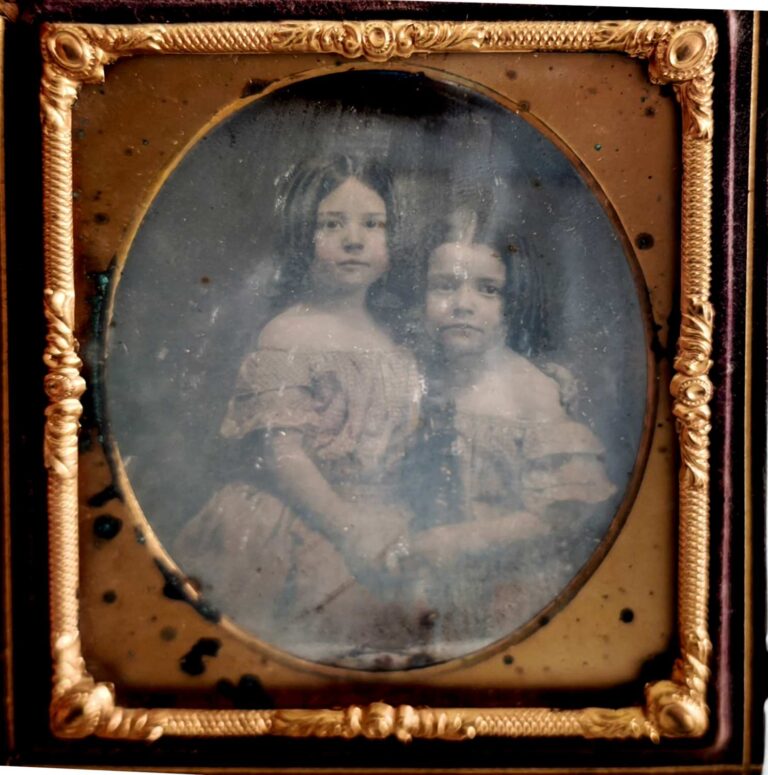
Daguerreotype

About The Process

CYANOTYPE

A mirror that remembers a moment — the process that made photography public.


In the early 1820s, the French inventor Nicéphore Niépce coated pewter plates with bitumen of Judea and left them in a camera obscura for the better part of a day, fixing the first known permanent photographic image. In 1829 he partnered with Louis-Jacques-Mandé Daguerre, a Paris theatre-set painter and showman best known for his Diorama spectacles. Niépce died in 1833; Daguerre carried the research on alone, and by the mid-1830s had found that a silvered copper plate, exposed briefly to iodine vapor and then developed over warm mercury, produced an astonishingly detailed image in minutes rather than hours.


In January 1839 the astronomer and politician François Arago announced the discovery to the French Academy of Sciences. Rather than let it be patented and controlled, the French government bought the process outright and, on 19 August 1839, gave it “free to the world” in exchange for lifetime pensions to Daguerre and to Niépce’s son — one of history’s first deliberate acts of open-sourcing an invention. That date is still marked as photography’s public birthday.

The daguerreotype was a sensation — Oliver Wendell Holmes called it “a mirror with a memory.” Studios opened across Europe and the Americas within months, and portraiture, once the preserve of painted miniatures, suddenly became affordable to ordinary people. Its reign was brief but complete: within fifteen years, the wet collodion process — cheaper, and reproducible from a negative — had all but replaced it.

How IT WORKS

1.        Polish a copper plate that has been clad in silver on one face to a flawless mirror finish — every later flaw in the image traces back to this polish.
2.        In darkness, expose the plate to halogen vapor (traditionally iodine, sometimes with bromine) until it takes on a pale golden cast, forming a thin light-sensitive layer of silver halide.
3.        Load the plate into a camera while still light-tight, and expose. Early lenses and slow chemistry meant exposures of several minutes; later refinements brought this down to a matter of seconds.

4.        Develop the latent image over warmed mercury inside a closed box. Mercury vapor bonds selectively to the exposed silver, building the bright highlights as a fine amalgam invisible until this step.
5.        Fix the plate to remove the remaining light-sensitive silver — originally in a salt solution, later in sodium thiosulfate, a fixer John Herschel proposed the same year — then gently gild it and seal it under glass.
6.        The result is a single, unrepeatable positive: a laterally reversed image visible only when the plate is tilted to catch light against a dark background. There is no negative, so no two daguerreotypes of the same sitting are ever quite identical.

About the Process

Experience the rich history of photography. Learn and create with alternative techniques that stand out.

Character

A true mirror surface — the image seems to float and shifts with viewing angle. Detail is extraordinarily fine, rivalling modern film, but the surface is delicate: easily fingerprinted or scratched, which is why daguerreotypes were almost always sealed in a case.

HANDLING

Mercury vapor development is acutely toxic. This isn't a step to reconstruct casually — practitioners today either work under expert supervision with real vapor capture and ventilation, or study the process without performing the mercury development itself.

LEGACY

Its reign was the shortest of the five, eclipsed within fifteen years by wet plate. Today it's practiced by only a handful of specialists rather than a broad revival community — its real legacy is archival: well-kept plates from the 1840s still survive in near-original condition, prized by museums and collectors for a sharpness few later processes matched.

Start Your Photographic Journey

Unlock your creativity by experiencing photography in a different light. Learn about historical processes and create stunning photographs.

Scroll to Top