CYANOTYPE

About The Process

CYANOTYPE

Sunlight and iron, no silver required — the process that gave the world the blueprint.

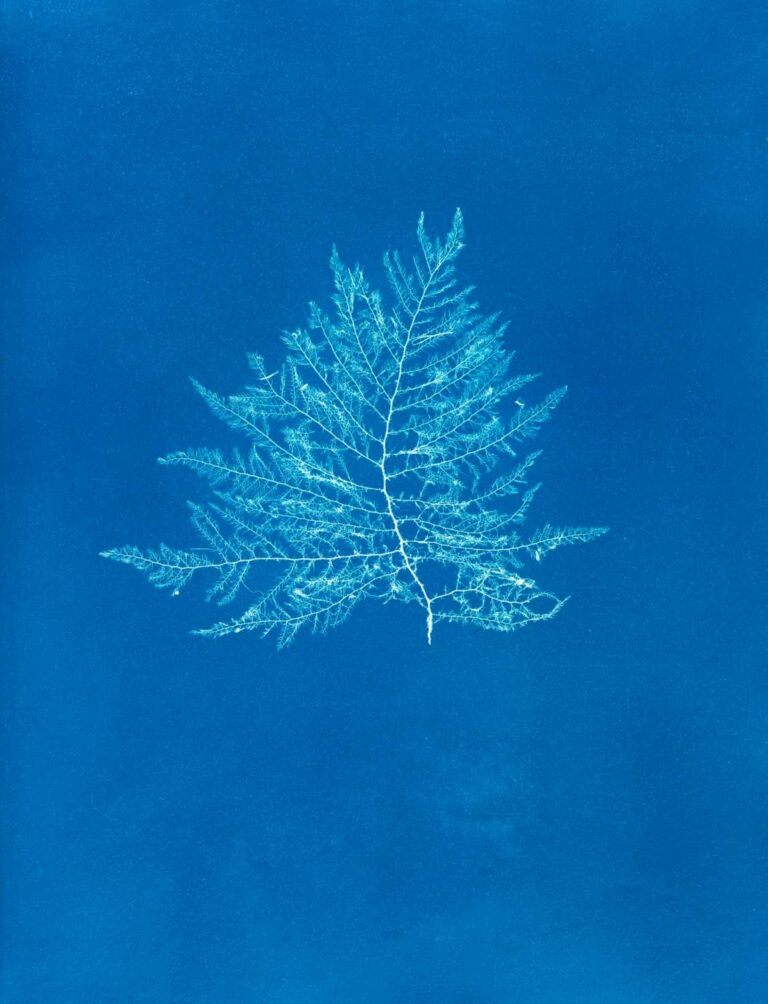
Sir John Herschel — the astronomer who coined the words “photography,” “negative,” and “positive,” and who found sodium thiosulfate’s use as a photographic fixer — discovered in 1842 that certain iron salts turn a deep Prussian blue after exposure to ultraviolet light. Unlike every silver-based process being worked out around him, cyanotype needed no precious metal and no camera. From the outset it was a contact-printing process: lay something flat and translucent (or opaque, for a silhouette) directly on the sensitized surface.

The following year, the botanist Anna Atkins adopted the process to record specimens of algae, arranging plants directly on sensitized paper and exposing them to the sun. Her 1843 volume, Photographs of British Algae: Cyanotype Impressions, is widely considered the first book ever illustrated entirely with photographic images.

Cheap, stable, and forgiving of amateur handling, cyanotype found a long second life far from the art world. For more than a century, engineering and architectural drawings were reproduced as white lines on blue paper by exactly this chemistry — the literal, original “blueprint.”

How IT WORKS

1.        Combine two iron-salt solutions to make a pale yellow-green sensitizer, and brush it evenly onto paper or fabric under dim, non-UV light.
2.        Let the coating dry fully in the dark. Once dry, the material is light-sensitive and will keep for a short while if shielded from UV.
3.        Lay something on top of it: a photographic negative for a full tonal image, or pressed leaves, lace, or any object for a photogram-style silhouette. Sandwich it under glass so it sits flat against the coating.

4.        Expose to strong ultraviolet light — direct sun is traditional, though a UV lamp works regardless of weather. The coating visibly shifts from yellow-green through grey as exposure proceeds.
5.        Wash in plain water. The unexposed sensitizer rinses away, and the exposed areas — already changed by the light — deepen into a stable Prussian blue as they oxidize and dry over the following hour or so.

About the Process

Experience the rich history of photography. Learn and create with alternative techniques that stand out.

Character

Rich Prussian blue on a pale ground, no separate fixing step — the wash itself sets the image. Tolerant of imprecise timing, and equally at home on paper, fabric, or wood. The blue continues to deepen for a day or two after processing.

HANDLING

Among the gentlest processes here — no silver, no solvents. Ordinary care (gloves, avoid ingestion, wash hands after handling) is enough.

LEGACY

The most widely practiced alternative process alive today, by a wide margin. Its low cost and low toxicity make it the standard first process for beginners, classrooms, and textile crafters (sun prints on cotton), while its original technical-drawing use gave the language the word "blueprint" long after the chemistry itself moved on.

Start Your Photographic Journey

Unlock your creativity by experiencing photography in a different light. Learn about historical processes and create stunning photographs.

Scroll to Top