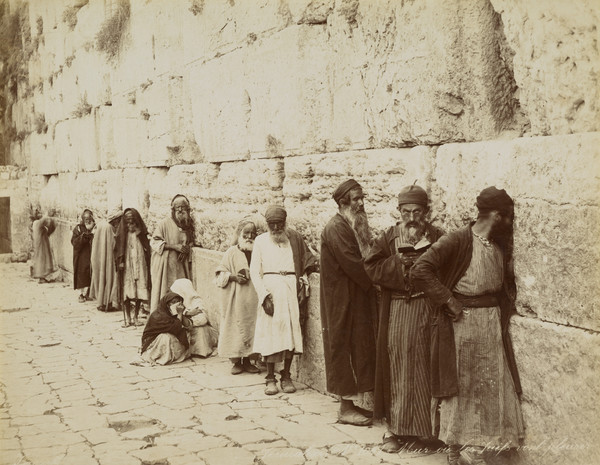
Frederick Scott Archer released his wet collodion process to the public in 1851, refusing to patent it so that anyone could use it freely. Within just a couple of years, it had reached one of the most photographed and least hospitable places it could have landed: Ottoman Palestine, where a wave of British and French travelers, missionaries, and biblical scholars were newly eager to bring back the Holy Land in photographic form rather than in paintings and engravings. What followed was a short, strange chapter in photography's history — one of pioneering individuals, brutal working conditions, and, within little more than a decade, a fully commercial tourist trade. And because a camera has no choice but to record whatever is actually standing in front of it, that same body of work left behind something its makers weren't necessarily setting out to create: concrete, dated visual evidence of the communities who were living in Jerusalem and across Palestine at the time, Jewish residents among them, rather than scripture-adjacent scenery alone.
The first plates in Jerusalem
James Graham, a Scottish former bank director working as a lay secretary for the London Society for Promoting Christianity Amongst the Jews, arrived in Jerusalem in December 1853 — barely two years after Archer's process was published. He took lodgings in a tower on the Mount of Olives and spent about two and a half years photographing the city and its surroundings, producing some of the earliest photographic images ever made of Jerusalem. His plates later found an unexpected second life as reference material for painters back in Britain, including Thomas Seddon and William Holman Hunt, who worked details of the Holy Land into their canvases from Graham's photographs rather than their own sketches.
Graham also passed the process on. Mendel Diness, a Jewish watchmaker who had settled in Jerusalem in 1848, learned wet plate photography from him and set up his own practice in the city during the 1850s — its first local, resident photographer. That the man behind Jerusalem's earliest resident studio was himself a member of the city's Jewish community is its own quiet piece of documentation: it places a Jewish Jerusalemite squarely at the origin of local photography, years before Palestine's Jewish population became a subject Western audiences debated from a distance. Diness's own story took a harder turn than his mentor's: he converted to Christianity, taking the name John, and the decision cost him both his marriage and his business, as the city's Jewish community boycotted him in response. By around 1859 he had left for the United States, changed his name again, and spent the rest of his life as a preacher, his pioneering photographs of Jerusalem going largely uncredited until historians rediscovered and exhibited them well over a century later, alongside Graham's, in 2007.
Chemistry against the climate
Wet collodion is an unforgiving process anywhere — the plate has to be coated, sensitized, exposed, and developed within minutes, all before it dries. It was invented in the mild, damp climate of England, and Palestine and the wider region gave it almost the opposite conditions to work in. The English photographer Francis Frith, who toured Egypt, Sinai, and Palestine from the mid-1850s and published his views in Egypt and Palestine, described working inside a sealed darkroom tent in weather so hot that, in his own account, the collodion "actually boiled" as he poured it onto the glass. The chemicals reacted dangerously in the heat, and windblown sand and flies settled onto the wet plates and pitted the finished image with pinholes. None of it stopped him: Frith hauled multiple cameras, one of them an oversized "mammoth" plate camera, along with crates of fragile glass and bottles of volatile chemistry, by boat, mule, and camel, and came home with negatives of a consistently high standard. Among the scenes he and his contemporaries kept returning to was the Western Wall, already Jerusalem's central Jewish place of prayer — one of several subjects that meant this era's fragile glass plates ended up preserving some of the earliest photographic evidence of Jewish religious life in the city.
An industry of Holy Land views
Within about fifteen years, individual pioneers had given way to a proper trade. Félix Bonfils, a French photographer, opened a studio in Beirut in 1867 and, with his wife Lydie and son Adrien, turned wet plate photography of the region into a family business on an industrial scale — thousands of images across Palestine, Lebanon, Egypt, and Syria, from biblical tableaux and posed portraits to panoramic landscape views. Their catalogue included Jewish worshippers at the Western Wall, images that went on to become some of the most reproduced 19th-century photographs of Jerusalem's Jewish community anywhere. Published as souvenir albums such as Souvenirs d'Orient in 1878, Maison Bonfils's photographs were sold directly to the Western tourists and pilgrims who were, by then, arriving in growing numbers to see the places their new photographs had already shown them. The studio continued under three generations of the Bonfils family until 1918 — by which point dry gelatin plates had already replaced wet collodion almost everywhere else, and the Ottoman era in Palestine itself was ending.
Why it still matters here
The whole arc — from Graham's tower on the Mount of Olives to Bonfils's Beirut storefront — happens inside less than seventy years, and almost entirely within the lifetime of a single photographic process. It's a distinctly local history, not just an imported one: a resident Jerusalem watchmaker learning a brand-new European invention well before most of Europe had, and a regional industry built specifically around this land's religious and historical weight. Practicing wet plate collodion today, in the same part of the world, sits directly on top of that history rather than alongside it.