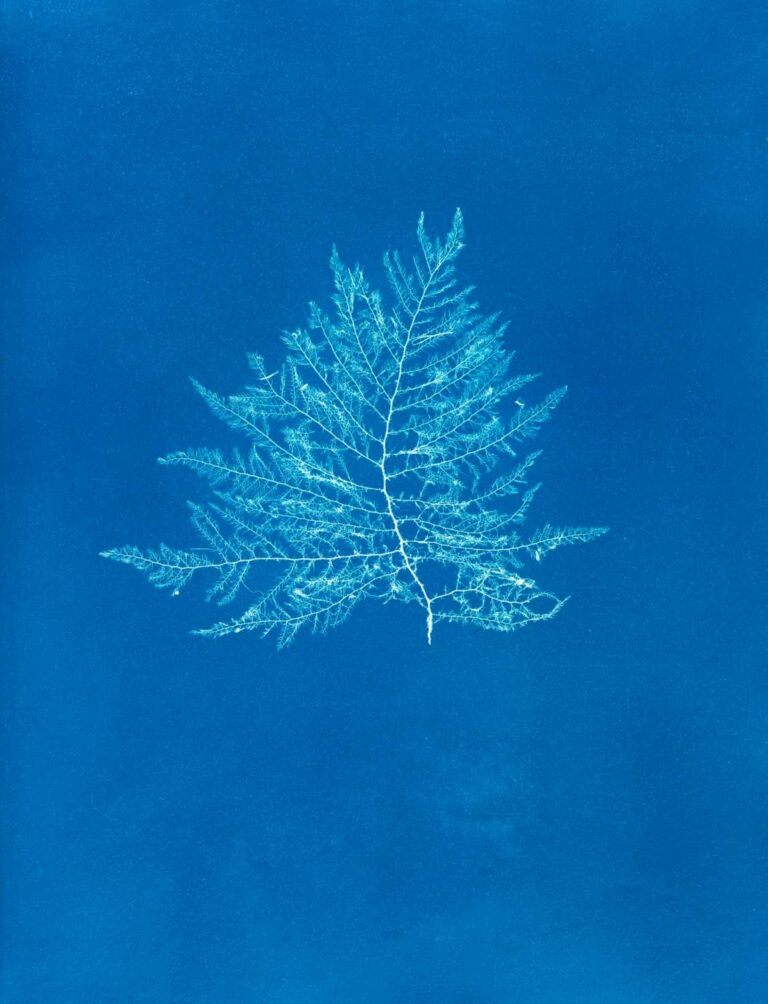
ANTHOTHYPE

About The Process

ANTHOTYPE

A print made entirely of plants, developed by sunlight and slowly undone by it too.

Anthotype grew out of the same burst of experimentation that produced cyanotype. John Herschel described light-sensitive plant juices in the early 1840s, and the astronomer and science writer Mary Somerville, a close correspondent of his, is also credited by some historians with early, independent work on the same idea — the record from that period is thin, and the two names tend to appear together in it.


Unlike every other process here, anthotype uses no chemistry beyond what can be pressed or steeped from a leaf, flower, or spice. It never became commercially or industrially useful, so it stayed a curiosity — a parlor experiment, later a favorite of botanists, and more recently of artists drawn to what it does that no other photographic process does.

Because the print can never be fixed, an anthotype is built to disappear: continued light exposure keeps bleaching it until the image is gone entirely. That built-in expiration has made it, in recent decades, a favorite medium for artists working with photography’s relationship to memory and impermanence.

How IT WORKS

1.        Extract pigment from plant material — flower petals, berries, leaves, or a spice such as turmeric — by crushing and steeping it, often in a little alcohol, to make a strong, filtered liquid dye.
2.        Brush the pigment onto paper in a few even coats and let it dry fully, away from strong light.
3.        Place a photographic negative — or a pressed leaf, or any translucent object — directly on the coated paper and sandwich it tightly under glass.

4.        Set it in strong, direct sunlight and wait. Where silver and iron processes expose in minutes, anthotype needs sustained daylight over days, and a dense pigment can take several weeks.
5.        The pigment bleaches away wherever light reaches it, leaving the image visible in the shielded, un-bleached areas. There is no wash and no fixer: the print is simply moved out of light and kept away from UV to slow — never stop — its eventual fading.

About the Process

Experience the rich history of photography. Learn and create with alternative techniques that stand out.

Character

Soft and painterly, with color entirely dependent on the plant chosen — turmeric golds, beet or berry pinks and purples, leaf greens. Naturally fugitive by design, which some printers treat as the point rather than a flaw.

HANDLING

By far the safest process in this collection — kitchen-cupboard materials and no toxic chemistry at all, which is part of why it travels well to a first session.

LEGACY

Never commercially useful, so it never really left its parlor-experiment roots — but that has made it a natural fit for today's "slow" and ecological photography movements, where its refusal to be fixed is read as a feature. Modern manuals and workshops built around the process have carried it from curiosity to a regular fixture of alt-process teaching.

Start Your Photographic Journey

Unlock your creativity by experiencing photography in a different light. Learn about historical processes and create stunning photographs.

Scroll to Top